Showing posts with label tips for artists. Show all posts

Sunday, August 12, 2018

The Road to Becoming a Plein Air Artist

By Guest Art Blogger Sue Kirkpatrick, Arab, Alabama (former resident of Iuka, Mississippi)

Sue Kirkpatrick.
(All images on this post ©2018|Sue Kirkpatrack unless noted otherwise)


I was solidly bitten by the art bug so now I have a bad case of passion for painting!!! Oil painting in particular. I have pursued oil painting by attending many workshops, buying art books, and buying more and more art supplies!
One of Marc Hanson's workshops at Courson Workshops in Pontotoc, MS
Painted/sketched this in Zhaoming Wu's workshop in Huntsville sponsored by Protege Atelier.

What I've discovered is that being an artist is a struggle in many ways. Actually, I got a late start-I was past middle age when most people start slowing down. A late start with a 90 degree learning curve would cause most people to question maybe not for me:
I had only taken two art courses in college, I was not at all comfortable with art language, and I had no intelligent art painting skills.

One of my favorite quotes:
"I am always doing what I cannot do yet, in order to learn how to do it.
  
Vincent Van Gogh


Kim English at Courson Workshops in Pontotoc, MS.  

I started going to art workshops. I found that every time I went to an art workshop my art painting skills improved and I started to learn some art language. Like I learned the word “Value” was a pretty important word in the art world. So I started trying to learn about value and the value scale and how to use correct values in painting. Did I say I being an artist is a struggle!

Here are a few photos of my paintings and photos from some workshops that I have been privileged to go to.

©2018|Sue Kirkpatrack

Reference photo credit :Steve West.
Painting ©2018|Sue Kirkpatrack

©2018|Sue Kirkpatrack

©2018|Sue Kirkpatrack

©2018|Sue Kirkpatrack

©2018|Sue Kirkpatrack

I'm still working on using correct value in my painting. I know I will continue to work on correct value skills until I die!!! Then value leads to color harmony, and to colors in your palette, then to limited palette, to composition, and to design!  And on an on and on! Van Gogh  was so right...
©2018|Sue Kirkpatrack


©2018|Sue Kirkpatrack

©2018|Sue Kirkpatrack


Then there are the artist, the past master painters, the living master painters, and all the really good painters in between!!!
©2018|Sue Kirkpatrack Sue painted this in Morgan Samuel Price's workshop in Dolonaga, GA at Anita Elder's.
As I went to workshop after workshop I also became acquainted with some of the most amazing people who were working to do the same thing I was doing, struggling to be an artist.
So many of these wonderful people were really already great artists who helped me tremendously!! And I am grateful for the help they gave me.


Sue's painting at the member's show, Shoals Art Guild took Best in Show
©2018|Sue Kirkpatrack
Sue Kirkpatrick is a retired teacher who lived in the lovely and historical village of Iuka, MS from 1998-2002. She attended the "W" in Columbus, MS her freshman year in college. After retiring as an educator she and husband, Terrell, now live in Arab, AL.
Sue began her artist journey by painting watercolor portraits while living in Iuka, MS.
Sue is now a pursuing oil painting by studying and attending plein air, figurative, and portrait workshops. She has studied with Kim English, Quang Ho, Jason Saunders, Marc Hanson, Morgan Samuel Price, Stapleton Kearns, and Zhaoming Wu among others. Sue paints most every day. Visit her website at: suekirkpatrickart.com


A big thanks to Sue Kirkpatrick for her story!


Follow this blog about Mississippi artists. In the coming weeks, this site will be publishing contributed articles by several plein air painters from the state of Mississippi. 

Contact Dot Courson at artist@dotcourson.com to find out how to contribute. 


I'm Social!

Click to join me right now at these links:
Website: www.dotcourson.com. 
Newsletter HERE
Instagram: @dotcoursonart

Monday, August 6, 2018

An Essay on Plein air and Studio Work

by guest blogger Curtis Jaunsen of Ocean Springs, MS

Plein Air East Beach, Morning 8x10 by Curtis Jaunsen

One of the things I’ve read about in art marketing essays is that the artist benefits from having a consistent “look” or style to their work. According to this theory, consistent work is easier for the potential collector to connect with, particularly if it is different enough from other artists work that it stands out just by that virtue.

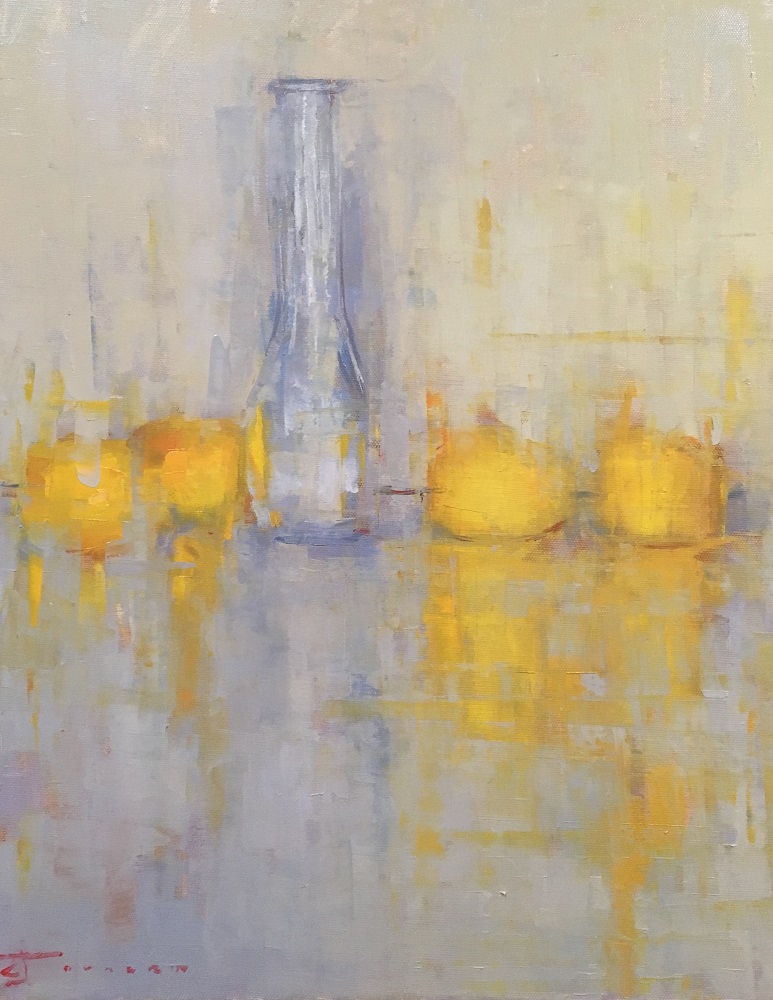
Lemons and Vase 18x18 by Curtis Jaunsen
                I don’t dispute this, it’s something I’ve been trying to be a little more careful about with my work, its just something that I haven’t really achieved yet. I paint inside my studio probably around 75 percent of my working time and outside, ‘en plein air”, the other 25 percent.

Studio Painting, Ocean Springs Sunset 24x36 by Curtis Jaunsen

 I probably paint an even number of landscapes and still lifes with an occasional portrait when the spirit moves me. When I first started out though it was almost exclusively still lifes and then always painted in the slow and careful method I learned from the Florence Academy of Art. In those paintings the subject was light and how it revealed the objects and surroundings in my still life setup. My sole focus was on capturing the atmosphere that gave it all a sense of life. 


A couple things happened over the last few years to change my approach. One was that when I went outside to paint I discovered slow and careful doesn’t really work. The light conditions change too quickly and the artist is almost required to be bold. The other was that after painting a few hundred still lifes in a classical, traditional manner the whole process started to feel repetitive and boring. 

Bowl with Lemons, 9x12 by Curtis Jaunsen
Studio Painting, Coast Harbor, 16x20 by Curtis Jaunsen
Now I have an almost two separate approaches when working. When I’m outside or when I’m inside painting something that I feel needs a more direct treatment I try to paint with the concern being accuracy. I look for the subtleties that require a bit of careful observation but then I try to put it on canvas pretty much as seen with little concern for paint handling, just straight forward brush on canvas. Hopefully these paintings have emotional content but if so probably more from the observation of the scene and less the painting process if that makes sense.
              
When I’m inside my studio however the rules are different. Whether it’s a landscape or still life being painted, I am still looking for subtleties, still looking to create a sense of close observation. I start off my painting as before, carefully drawing and establishing the accurate values and colors, but rather than refine and continue this process, while the paint is still wet, I like to use a variety of methods to move it around, blending objects into the background and vice versa. The process becomes a lot more important, making the paint and how its pushed around as important as the scene being rendered. In the studio I use several different palette knives, a large scraper, a few different putty knives, tissues and paper towels and of course different brushes to put paint down and move it around. 

Glass Vase and Lemons 16x20 by Curtis Jaunsen
During the process I’m looking at the canvas more and the subject less. I can push it into a more realized rendering of the subject or a more abstracted direction. Which direction I go while painting is determined by what I’m seeing on the canvas and whether I think it’s working or not. This open ended process makes the final painting more of a discovery than something predetermined. The best result is one where both the scene and the painted surface look fully observed, meaning you can tell the artist really understood the shifts of light, the gesture of the forms in the scene being painted and the paint itself.


Plein Air- Biloxi Harbor 9x12 by Curtis Jaunsen
One thing I think I’m going to try in the future is bringing some of the studio methods outside. Its good to keep trying new things and maybe that can lead to more consistency.


               Curtis Jaunsen is a Mississippi artist who lives on the Gulf Coast. Formerly an architect practicing in Atlanta, Curtis moved with his family to Mississippi almost twenty years ago to be closer to his wife’s extended family. He began his life as artist by first studying classical painting at the Florence Academy of Art in Florence, Italy. Since 2005 Curtis has been painting portraits, still lifes and landscapes, outside or in his studio in Ocean Springs, MS.


Curtis’s plein air paintings are available at the Pink Rooster Gallery in downtown Ocean Springs. His studio work, including portraits, landscapes and still lifes can be see at the Carol Robinson Gallery on Magazine Street in New Orleans. He will be having a solo show at Carol’s gallery this September 8th. Additionally his work can be seen online at curtisjaunsenart.com. A link to his facebook and Instagram pages can be found on his website.

A big thanks to Curtis Jaunsen for his story!


Follow this blog about Mississippi artists... In the coming weeks, this site will be publishing works by several plein air painters from around Mississippi. 

Contact Dot Courson at artist@dotcourson.com to find out how to contribute. 


I'm Social!

Click to join me right now at these links:
Website: www.dotcourson.com. 
Newsletter HERE
Instagram: @dotcoursonart

Sunday, July 8, 2018

Lessons Learned From Painting Daily


By Guest Blogger artist Carol Roark


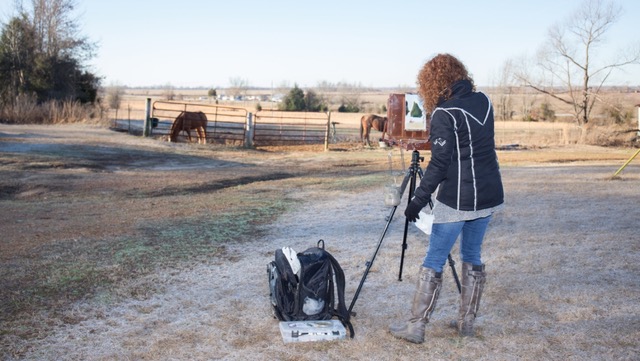
Carol painting on her farm north of Charleston, Mississippi 
 In the fall of 2017 with the encouragement of the CSA Award (Community Supported Arts) given by the Yoknapatawpha Arts Council, I challenged myself to paint a painting a day for 200 days.  Over the years, I have heard several instructors talk about this challenge and how it would strengthen you as an artist. I had even done a 30 day challenge here and there, but I had never pinned myself down to a commitment such as this.


 I signed a contract with myself.

What better way to commit yourself to a project, right?... and started to paint. I gave myself a few stipulations:
    1. All of the work would be plein air or if conditions were just impossible, at least from life.
    2. I would not spend more than an hour on each painting. I wanted these paintings to be studies. I wanted to concentrate on mass and value and not details. I wanted to experiment and challenge myself.     
    3. Paintings would be small - no larger than 8” x 10” and most no bigger than 6”x 8”.


What did I learn? 

The first thing I tell everyone who asks me this question, is that I should have done this 25 years ago. The visual education and brush mileage that I gained feels unmeasurable to me. I felt like what I imagine actors feel like when they stay “in character” while working on a specific role. After about 3 weeks, it was like I was always “in character” as a painter. If I wasn’t painting with a brush, I was sketching. If I was sketching, I was painting in my head.
 
Carol happily painting in the happiest place on Earth” 
I tend to be somewhat shy, especially when I am painting, but I learned to break out of my shell and become comfortable painting anywhere (even Disney World!). I also developed a love for the southern landscape and the changing of the seasons like I never have before. Most importantly, I got better and I realized there is NO substitute for brush miles and this is coming from someone who has been painting for many years, just not as focused as this.
 
Carol painting at the Windsor Ruins, a bucket list check!
My project has now come to an end, but I am still on the roller coaster and I’m not sure I ever want to get off - a day or two away from the easel and I almost feel lost. I am now spending my time focusing on larger works and implementing what I learned over the past several months. I also never go more than week without painting plein air.
 
Carol with a few of her 200 paintings during the CSA reception at the Powerhouse in Oxford
So I challenge anyone reading this to try a daily painting project. Go at least 60 days, preferably more. It will rain, the wind will blow, the bugs will come out and it will be hotter and colder than you can imagine, but I can promise you will come away a better painter with an amazing experience.
 Carol Roark is a full time artist and teacher living on the bluff of the Mississippi Delta. She received her BFA from Mississippi State in 1992 and then continued to study painting with artist Sammy Britt after graduation.  She has also had the privilege of studying with Kim English, Jason Saunders and Marc Hanson (who was an influential  mentor through the 200 day project) 

You can view more of her work on her website at www.carolroark.comon Facebook under Roark Studios and on Instagram @roarkstudios.

A big thanks to Carol Roark for her wonderful post!


Sunday, June 12, 2011

Mississippi Heat

Summer's heat in Mississippi in the summer is stiffeling. It's technically still spring but its already profoundly humid and hot.

When outside painting I wear a device/ product called Cool Downz which is basically a neck tie that has a gel inside that stays moist and cool. You soak it in water and tie it around your neck to keep you cool. I also wear a lot of sunscreen, a hat and bug spray. I drink bottled water too-  to try and stay cool. But I usually eventually resort to the studio full- time by July.

Artists find refuge inside by July in Mississippi except for a few hardened souls. I 'm a softie. I know very few Mississippi painters who paint daily - dare I say even weekly during July and August summer months.

This month (June) I just did a small painting of our pasture late one afternoon. I gave it to my neighbors who I thought would want it as they came and sat out on their front porch to watch me paint:

We went to Sardis Lake (Redneck Riviera?) the first week of June and although heat indexes got up to over 100 degrees, I managed this little painting one morning:

Both these litlle painting "studies" come INSIDE where they may become larger works finished in my studio.